
Initial Insights from the 7th Annual Future of Work Conference
November 4, 2025

Tuesday, October 28th, marks the 7th anniversary of Pasadena City College’s (PCC) Future of Work Conference (FOW), presented by its Division of Economic and Workforce Development (EWD). Perhaps not surprisingly, the theme this year focuses on educational and community resilience in the face of disaster and catastrophic loss.
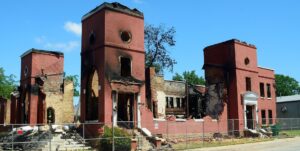
With the City of Pasadena on the front line of the recent Eaton wildfire, its constituents are dealing daily with the fallout from the conflagration. Traditionally stable supply lines are stressed as more people vie for those (often limited) resources, while support services often lag in terms of the personnel and funding available to meet fire survivor needs. In total, it’s estimated that the economic losses to the region could be as much as $250 billion, while the costs to rebuild are, as yet, indeterminable.
At this year’s FOW conference, PCC EWD leaders are inviting their friends, colleagues, and industry partners to discuss how community colleges can drive recovery and economic renewal after calamity strikes. Their fundamental premise: California’s community colleges are uniquely situated to provide guidance, personnel, and resources in times of catastrophe to avoid and/or reduce losses and speed the repair and recovery processes.
At the heart of the PCC EWD conversation is the value of education and how it elevates a community’s profile and experience. Obtaining a quality education is typically fundamental to achieving success at the individual, local, national, and even international levels. A ‘general’ education facilitates a person’s participation in the various aspects of ‘community’: political, social, and economic, among others. Advanced education, including Certifications, Associates, Bachelor’s, Master’s, and higher degrees, adds to economic strength by enhancing innovation and entrepreneurship at the regional, state, and national levels. In most cases, the benefits (usually always) significantly exceed the costs and tribulations involved in attaining a higher educational milestone:
An undercurrent running through all the aforementioned information is that those data points were gathered when systems – industrial, government, community – were functioning well and operating as expected. Those systems, however, weren’t designed to be responsive when a catastrophe hits, and the consequences of that lack of strategy are often painfully apparent in the depth, breadth, and scope of the damages that are caused.
Instead, the PCC EWD FOW theme proposes that resiliency, response, and recovery be built into today’s educational systems (at all levels) as a natural part of their subject matter. The theme supposes that disasters, natural and otherwise, will be forever on the horizon, so why not develop the necessary response processes and procedures before those needs become imperative? As with the development of every curriculum and program, designing a comprehensive and effective disaster recovery (DR) strategy requires collaboration and input from a variety of sources, which is precisely what the PCC EWD FOW intends to convene.
PCC EWD is inviting a myriad of professionals to share their perspective through this increasingly critical lens:
The fundamental belief of the conference is that a community that strategizes responses to economic growth and almost inevitable catastrophe is better prepared to expand the first and withstand the second. Through this FOW conversation, PCC EWD intends to develop tools, understandings, partnerships, and resources that will facilitate enhanced resilience when – not if – another disaster approaches Southern California.